


Location

Call Us Now
Location
The lending industry is moving toward systems that can make smarter decisions and prompt actions with minimal human intervention. From AI-powered underwriting to embedded finance and real-time risk analysis, banks, NBFCs, and fintech startups are investing heavily in automation.
While automation in lending has also evolved beyond digitisation of lending forms, quick loan approvals, and basic Robotic Process Automation (RPA) to meet rising customer expectations for instant, personalised, yet reliable lending services. This shift is propelling the industry toward a new era of intelligent lending, featuring “Agentic AI” and other advanced capabilities.
This blog examines what automation in lending looks like in 2026 and beyond, as well as which automation features empower the lending industry.
Loan automation is the use of advanced technologies such as Artificial Intelligence (AI), Machine Learning (ML), workflow automation, data analytics, and intelligent decision-making systems to streamline and automate the entire lending lifecycle. The implementation of automation enables lending institutes in reducing manual effort, accelerate loan processing, improve risk assessment, and deliver faster, more personalized lending experiences.
Traditionally, automation in lending was largely limited to rule-based workflows, predefined credit scoring models, application intake automation, document classification, and OCR-based data extraction. While these technologies helped streamline portions of the lending process, they still required significant human involvement for document verification, exception handling, underwriting decisions, and risk assessment.
This created significant technological complexities within the operational flow of banks and NBFCs, restricting the use of automation to a narrow horizon. On the other hand, the digital lending industry projects an instant, inclusive, and invisible lending experience to its customers.
Hence, to ease these complexities and achieve the objective, the industry started to shift. A shift that continues to shape lending automation in 2026 and beyond.
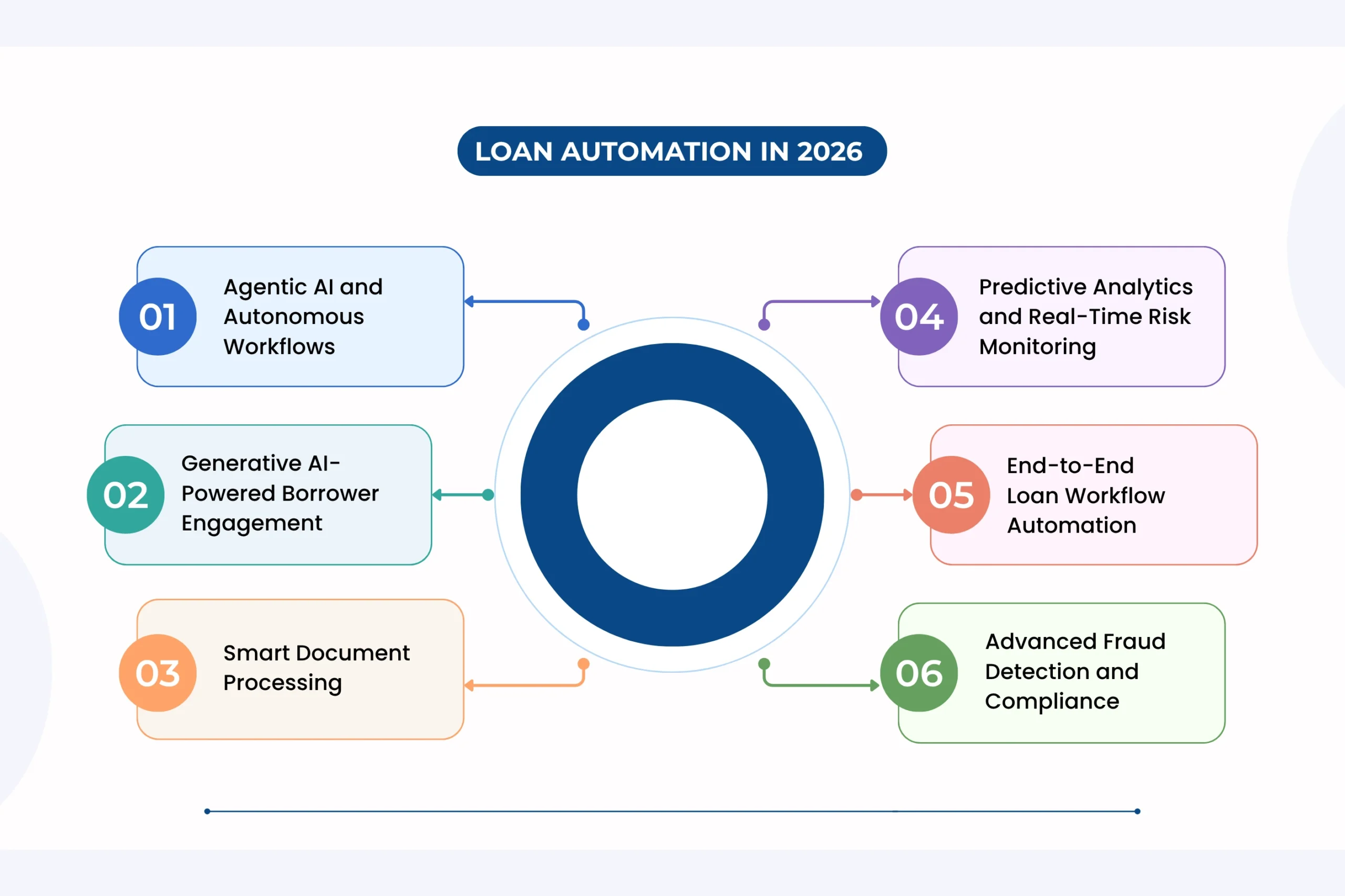
The lending industry has traditionally evolved at a measured pace, but the scale and speed of change today are unprecedented. Advances in AI, data ecosystems, cloud technologies, and digital-first customer expectations are fundamentally reshaping how lenders assess risk, deliver credit, and engage borrowers.
As we move into 2026 and beyond, automation is no longer limited to digitising forms or automating repetitive tasks. It is evolving into an intelligent ecosystem capable of making decisions, understanding customer behaviour, predicting risks, and creating highly personalised borrowing experiences. The future of loan automation will be defined by technologies that enable lenders to become faster, smarter, and more resilient.
Artificial intelligence is entering a new phase. Instead of simply analysing information and offering recommendations, AI systems are increasingly capable of independently executing tasks and making decisions within predefined boundaries.
In lending, Agentic AI has the potential to transform the entire loan lifecycle. These intelligent systems can gather borrower information, verify documentation, evaluate risk, identify missing information, communicate with applicants, and even recommend suitable financial products, all with minimal human intervention.
Autonomous workflows will also significantly improve operational efficiency by automating document verification, income assessment, credit scoring, underwriting support, and compliance checks in real time. While human oversight will remain essential for complex cases and regulatory accountability, Agentic AI will allow lending teams to focus on higher-value decision-making and customer relationships.
Generative AI is transforming how lenders interact with borrowers throughout the lending journey.
AI-powered assistants can help borrowers complete applications, explain loan products, answer policy-related questions, provide repayment guidance, and offer personalised recommendations through conversational interfaces.
Benefits include:
As conversational AI becomes more sophisticated, lenders will be able to provide personalised support at scale while reducing operational costs.
Despite years of digital transformation, documentation remains one of the most time-consuming aspects of lending. Financial statements, bank records, identity proofs, income documents, and legal agreements often require extensive manual review.
Smart document processing combines OCR, Natural Language Processing (NLP), machine learning, and increasingly Generative AI to automate the extraction and validation of information from financial statements, income proofs, identity documents, bank statements, and legal agreements.
Modern document processing systems can:
The impact goes beyond efficiency. Improved document processing significantly reduces human errors and strengthens compliance processes by ensuring greater accuracy and consistency throughout the loan journey.
As lending volumes continue to grow, intelligent document processing will become an operational necessity rather than a competitive advantage.
Traditional risk assessments typically occur during loan origination. Future lending models are shifting toward continuous risk monitoring powered by predictive analytics and machine learning.
Modern automation platforms can analyse borrower behaviour, transaction patterns, repayment activity, and portfolio performance in real time to identify potential risks before they become serious issues.
These capabilities enable lenders to:
As economic conditions and borrower circumstances change, real-time risk monitoring will help lenders move from reactive risk management to proactive portfolio optimisation.
Lenders are increasingly moving toward end-to-end automation that connects every stage of the loan lifecycle from loan origination to loan management. By integrating origination, underwriting, servicing, payments, collections, and compliance into a single automated ecosystem, lenders can respond more quickly to changing customer expectations, launch new lending products faster, and scale operations without proportionally increasing costs or resources.
The growth of digital lending has brought significant benefits, but it has also created new vulnerabilities. Fraud techniques are becoming increasingly sophisticated, making robust risk controls essential.
Modern loan automation platforms are leveraging artificial intelligence and advanced analytics to identify unusual behaviours and detect potential fraud in real time through:
At the same time, regulatory expectations continue to increase. Compliance requirements surrounding data privacy, anti-money laundering, customer due diligence, and responsible lending are becoming more complex across global markets.
Automation is helping lenders manage these obligations more effectively by creating transparent audit trails, improving reporting accuracy, and ensuring consistent adherence to regulatory requirements.
Loan automation in 2026 and beyond will be defined by intelligence, connectivity, and adaptability. The industry is moving toward systems that not only automate tasks but also understand context, make informed decisions, and continuously learn from data.
The lenders that will thrive in this environment are those willing to embrace emerging technologies while maintaining a strong focus on trust, transparency, and customer experience.
Automation is no longer simply about efficiency. It is becoming the engine that powers the next generation of lending, one that is faster, more inclusive, more secure, and better equipped to meet the evolving demands of borrowers and financial institutions alike. To enable you with these abilities, LendMantra takes pride in catering to banks. NBCSs and NBFIs with exclusive futuristic loan automation services that are secure, reliable, and enable banks and non-banking financial groups with faster and seamless lending services. For more insights, check LendMantra.
With AI enabling loan automation, the lending process becomes seamless, eliminating human intervention in tasks such as quality checks (QC), loan approvals, and background verification. Where these tasks previously took up most of loan approval time, loan automation makes this process seamless, reliable, and faster than ever before. This enables lenders to lend money when it is actually required without delayed credits into the borrower’s account.
The key trends shaping the future of loan automation are:
In fact, it is also contributing to enhancing operational efficiency by hyperautomation and dynamic servicing.
Definitely, loan automation helps reduce approval time and operational costs with automated loan processing and by eliminating human intervention.
Predictive analytics play a crucial role in next-gen loan automation. It helps with instant risk assessment, utilising alternative data, and forecasting borrower repayment behaviour. It enables lenders with real-time intelligence to streamline approvals, replacing static credit checks.
