


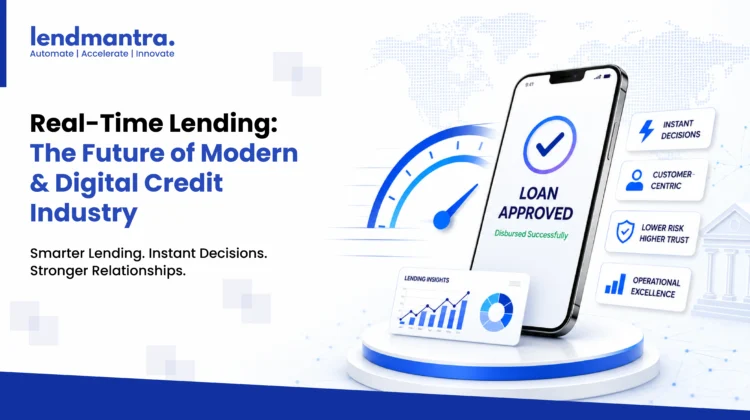
The credit industry is changing rapidly, and digital lending is driving the transformation. Thanks to automation, cloud platforms, and smart risk management tools, processes that once took weeks or years can now happen in a few clicks and minutes.
As borrowers need speed and convenience, lenders are always seeking digital lending solutions that deliver faster approvals, a better customer experience, and more scalable operations.
However, the overall shift is not just about replacing paper with software. It is all about redesigning the overall lending journey. Hence, real-time lending, where loan applications are assessed, approved, and disbursed within minutes, is becoming a practical and preferred solution for lenders and customers.
In today’s post, we will explore how real-time lending is revolutionizing the entire credit industry and how AI in lending is helping to shape the future of lending. Let us begin.
What Does Real-Time Lending Mean?
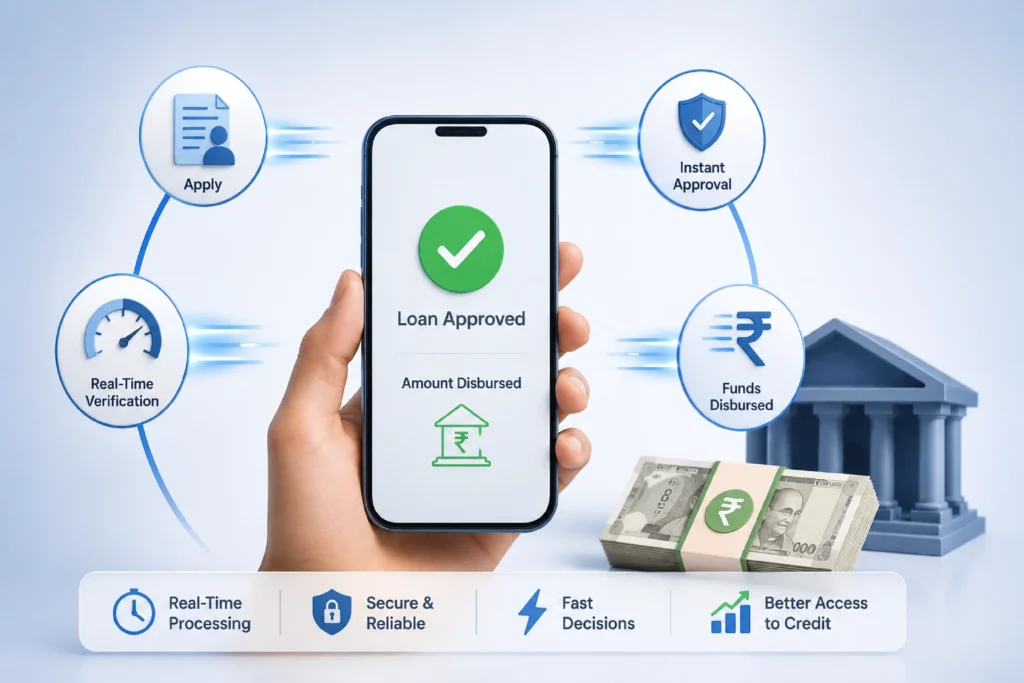
Real-time lending is an automated system in which a borrower applies for a loan, the platform assesses the application, and the borrower receives the results immediately. This is all done through live data, automated workflows, and instant data engines to decide the user’s creditworthiness.
For lenders, this solution allows for faster loan processing along with minimal operational bottlenecks. Furthermore, it also helps lenders to respond to changing risk signals in real-time.
A strong real-time lending platform can support multiple loan products, serve diverse customer segments, integrate with banking systems and third-party data providers, and manage the entire loan origination process through a single unified platform.
This is why banks, NBFCs, and fintechs are increasingly adopting real-time lending as a core capability that improves customer experience, operational efficiency, and business growth.
Benefits of Real-Time Lending
Real-time lending redefines the overall lending process. Here are some of the key benefits of it:
Faster Approvals Rates
Automated decision-making allows lenders to process, analyze applications, and provide approvals within a few minutes. Also, the system keeps borrowers informed throughout the process. This significantly improves overall customer satisfaction and also lowers the application abandonment rates.
Smarter Risk Management
Continuous monitoring of borrowers’ behavior and real-time data analysis helps the lender to identify potential risks at an early stage. This proactive approach allows firms to address issues at an early stage before they become big ones.
Amazing Flexibility
Modern lending platforms allow firms to quickly modify lending policies, risk parameters, and other workflows in response to changing market conditions and regulatory demands. This ensures all the operations remain agile and responsive as well.
Compliance and Transparency
With real-time lending, every action and decision in the process is recorded automatically, creating a complete audit trail. This improves overall transparency, simplifies the regulatory reporting task, and helps in minimizing errors, compliance gaps, and other disputes.
Wider Market Reach
By leveraging alternative data sources and intelligent risk models, lenders can extend their credit to underserved customers while still maintaining robust risk management standards. This allows the institutions to expand their customer base and unlock new growth opportunities.
In the end, modern digital lending platforms create a win-win scenario for both lenders and borrowers. It allows lenders to improve efficiency, while borrowers experience a fast, transparent, and personalized lending experience.
Impact on Customer Experience
One of the biggest benefits of real-time digital lending is the improved customer experience. Instead of waiting for long hours or visiting multiple locations, customers can complete their entire loan process online in a few clicks and minutes.
With the help of mobile devices and instant status updates, digital lending makes the overall process feel fast, simple, transparent, and secure.
This shift really matters today because borrowers expect convenience at every step. A well-designed digital lending platform allows users to:
- Create profile
- Upload documents
- Track progress
- Receive real-time notifications
This helps to eliminate the unique challenges and builds trust. Moving on to fewer manual steps also means fewer errors and results in a smoother application process. This is helpful for people, especially first-time users applying for loans on their phones or those who want to apply after business hours.
On the other hand, providing better customer service is not just a feature but a competitive advantage. When borrowers have an easy interface, quick responses, and know their application status, they are more likely to complete the process and return for future financial needs. This reduces abandonment rates and serves as a silent marketing tool for your business.
Therefore, digital lending software that enables real-time lending does more than automate operations; it creates a smooth lending journey that is modern, responsive, and borrower-friendly.
The Role of AI in Real-Time Lending
AI in lending is one of the most transformative forces reshaping the credit industry. As we all know, initially, traditional credit assessments relied heavily on CIBIL scores and manual document reviews. The overall process was slow, expensive, and sometimes even unfair.
Today, AI changes all of that. Machine learning (ML) models can now analyze hundreds of data points in real time, including transaction history, behavioral patterns, employment data, and more. This helps deliver faster, more accurate credit decisions on the spot.
Research also suggests that adopting AI-driven underwriting can reduce the overall loan processing time by up to 80% and also identifies risk signals that generally get missed by a manual approach.
Apart from underwriting, AI in financial services also helps in fraud detection, customer segmentation, dynamic pricing, and generating personalized loan offers. This overall approach makes the lending journey smooth and not like a bureaucratic hurdle.
A Step-by-Step Guide to Real-Time Decisioning in a Lending Platform
Implementing real-time decisioning is not simple and cannot be done directly into the system. A phased approach allows financial institutions to minimize risk, demonstrate value quickly, and scale with confidence. Here are some key steps to consider:
Real-time decisioning cannot be implemented in the system in one go. However, a planned approach allows financial firms to minimize the risks, enjoy the values and scale with confidence. Here’s a step-by-step guide:
Begin with a Pilot Project
Start the approach with a specific loan product or customer segment where real-time decisioning can deliver immediate and significant business value. A successful pilot project helps to validate the approach, analyze the results, and ease further adoption.
Build a Unified Data Foundation
Real-time decisions provide accurate results when they have high-quality data behind them. The consolidated borrower information is gathered from internal systems, credit bureaus, alternative data providers, and several other external sources to create a unified view.
Automate the Core Lending Process
Next, streamline critical processes like application reviews, document verification, underwriting and compliance checks. Automating these workflows will reduce manual effort, speed up the approval process, and improve overall efficiency.
Monitor Performance and Scale
Leverage dashboards, analytics, and performance metrics to monitor results in real time. Furthermore, continuous analysis helps institutions refine risk models, improve overall decision accuracy, and adapt to changing market dynamics.
Scale Across the Lending Ecosystem
Once the pilot project is successful, you can launch the solution into the production environment. The firms can further expand real-time decision-making capabilities across multiple lending products and business domains, such as mortgages, commercial loans, microfinance, and more, to maximize overall organizational impact.
Real-time decisioning is not a one-time transformation but an ongoing journey. By adopting a step-by-step, phased, and strategic approach, financial firms can successfully implement real-time decisioning, minimize the disruption, and unlock long-term success across the lending lifecycle.
Navigating the Challenges of Tomorrow
While the future of lending is promising, it comes with great speed and efficiency, this transition comes certain challenges, too. Moving entirely to digital ecosystems also introduces new cybersecurity risks and complex data privacy concerns.
As more customer information is being processed online, protecting sensitive data from cyber threats becomes a top priority.
Thus, financial institutions must always ensure that their automated underwriting systems are transparent and are 100% compliant with evolving regulations related to data security and bias prevention. The Reserve Bank of India has placed emphasis on responsible practices through its Digital Lending Guidelines and cybersecurity frameworks. But to ensure these are implemented properly, lenders have to be extra vigilant and compliant.
Additionally, as the institution grows, scalability is one more key consideration. As loan volumes grow or fluctuate unexpectedly, the AI-powered digital lending solutions should be flexible enough to handle such sudden spikes without any significant downtime.
Overall, the success in this new era is completely for the organizations that embrace intelligent solutions while maintaining strong security, compliance, and customer trust.
Check This: RBI’s Updated Rules on Digital Lending Directions 2025 | Lendmantra
Conclusion
The credit industry has now reached a turning point, and real-time lending is no longer a futuristic topic. Today, it has become the basic expectation in the modern era, and relying on outdated and disconnected systems is no longer enough.
Lenders need modern, automated solutions that are agile, efficient, and provide better customer experiences. From leveraging the power of AI in financial services to implementing a scalable digital lending solution, firms can now redefine the overall credit journey.
LendMantra is one such solution that empowers banks, NBFCs, fintech companies, and other financial institutions to simplify their entire lending lifecycle. It offers LOS and LMS systems that can be adopted as per usage to achieve faster approvals and deliver exceptional customer experiences.
Contact us to know how LendMantra can support your lending journey.
Frequently Asked Questions
What technologies enable real-time lending platforms?
Real-time lending platforms rely on a highly integrated modern technology stack:
- Cloud Computing: Provides the on-demand processing power and scalability needed to analyze vast amounts of data instantly.
- Artificial Intelligence (AI) & Machine Learning (ML): The model performs intelligent credit decisioning by analyzing vast datasets and identifying risk patterns that were generally being missed by traditional processes.
- Open Banking & Account Aggregation: Allow lenders to access real-time financial data directly from a borrower's bank account (with consent), enabling richer and more accurate assessments.
- Optical Character Recognition (OCR) & AI: Instantly read, extract, and verify data from uploaded identity documents or tax returns to prevent fraud.
- eKYC & Digital Identity Verification: Uses biometrics, document scanning, and facial recognition to verify borrower identities in seconds.
- Automated Decisioning Engines: Run complex business logic, risk matrices, and check regulatory compliance instantly.
- Instant Payment Infrastructure: Models such as UPI in India or real-time gross settlement systems ensure that once a loan is approved, disbursement happens immediately.
Together, these technologies form the backbone of a modern, end-to-end digital lending ecosystem.
What are the key benefits of real-time lending for financial institutions?
The biggest benefits include faster approvals, improved operational efficiency, better risk assessment, and a stronger customer experience. Financial institutions can handle more applications with fewer manual steps, which helps to reduce costs and improve in terms of scalability and customer experience too. Furthermore, real-time lending also allows financial institutions to compete more effectively in a fast-moving digital market.
Can real-time lending help reduce loan processing times?
Yes, real-time lending can significantly reduce loan processing times by automating verification, scoring, and approval steps. Instead of waiting for manual reviews, lenders can use digital systems to make faster decisions based on available data. This shortens the overall turnaround time and helps borrowers to get funds sooner.
What role does real-time lending play in financial inclusion?
Artificial intelligence helps in real-time lending by analyzing large volumes of data, identifying patterns, and supporting faster risk decisions. It can improve overall fraud detection, automate credit scoring, and generate personalized loan offers based on borrower behavior. AI also helps lenders to make smarter decisions with greater consistency and less manual effort.
How does artificial intelligence support real-time lending decisions?
Loan software for lenders helps to automate the full lending journey. From application intake to approval, disbursal, and repayment tracking, everything is done online. Thus, it reduces paperwork tasks, improves accuracy, and gives lenders better control over the process and compliance. In simple terms, AI makes lending faster, more organized, and easier to scale.
References
- https://newgensoft.com/in/resources/article/transforming-digital-lending-with-real-time-decisioning/
- https://www.federal.bank.in/the-future-of-digital-lending-in-india
- https://www.allcloud.in/digital-lending-software
- https://www.companionlink.com/blog/2026/06/how-ai-is-transforming-real-time-lending-decisions/amp/
- https://www.capgemini.com/insights/research-library/ai-powered-credit-decisioning-systems/
- https://bakerhill.com/blog/lending-software-solution/
- https://www.turnkey-lender.com/blog/7-digital-lending-trends/
- https://www.loanpro.io/blog/digital-transformation-in-lending/
- https://www.nucleussoftware.com/blog/embracing-the-future-technology-trends-for-modernizing-digital-lending/
