


AI-powered credit scoring is changing the way lenders assess borrowers. This new approach is particularly helpful for people in semi-urban and rural areas who often struggle to get loans through traditional methods.
Many potential borrowers don’t have extensive credit histories and can easily be overlooked. Artificial intelligence-powered credit scoring helps financial institutions evaluate these individuals by using a wider range of information, such as spending habits and payment patterns, rather than just relying on past credit scores. This broader view allows lenders to better understand borrowers who may not fit typical profiles.
As we take a closer look at how AI is transforming credit scoring, we’ll discuss how it works, its benefits compared to traditional methods, and what lenders need to know to make the most of this technology.
- What Is AI-Based Credit Scoring?
- Why Traditional Credit Scoring Is No Longer Enough?
- Traditional Credit Scoring vs AI Credit Scoring
- Benefits Of AI Credit Scoring
- How Does AI Credit Scoring Work?
- How AI Can Transform MSME Lending?
- Key Considerations When Implementing AI Credit Scoring Systems
- Best Practices For Adopting AI Credit Scoring
- Final Thoughts
- Frequently Asked Questions
What Is AI-Based Credit Scoring?
AI-based credit scoring is a technology-driven method of assessing a borrower’s creditworthiness using artificial intelligence (AI) and machine learning (ML). It helps financial institutions engaged in lending, such as banks, and all financial institutions that are into lending and NBFCs, evaluate loan applicants by analyzing large volumes of data and identifying patterns that indicate the likelihood of repayment.
The process begins by collecting relevant borrower information, such as credit history, banking transactions, income details, spending behavior, and other financial data. Machine learning models analyze this information and compare it with historical lending outcomes to predict credit risk. Based on these insights, the system generates a credit score or risk rating that supports lending decisions.
Unlike traditional rule-based models, AI can process thousands of variables simultaneously and detect complex relationships that may not be immediately visible to human analysts. It also continuously improves its accuracy by learning from new borrower and repayment data over time.
For banks and NBFCs, AI-based credit scoring enables faster loan evaluations, more consistent risk assessment, improved decision-making, and greater scalability, making it a valuable tool in today’s digital lending ecosystem.
Why Traditional Credit Scoring Is No Longer Enough?
Credit scoring models built around bureau data and historical repayment records served the lending industry well for decades. However, the digital lending ecosystem has fundamentally changed the nature of borrowers, data availability, and risk assessment.
Today’s lending market includes gig workers, platform sellers, MSMEs, freelancers, and first-time borrowers whose financial behavior is often reflected more accurately through digital transactions than conventional credit files. As lending expands into underserved segments, traditional scoring approaches face structural challenges.
1.Overdependence on Bureau Data
Traditional models rely heavily on credit histories, limiting visibility into borrowers with thin or no credit files. This can exclude creditworthy customers from formal lending.
2. Focus on Historical Performance
Past repayment behavior does not always reflect a borrower’s current financial condition. Rapid income and business changes can create new risks or opportunities.
3. Inflexible Rule-Based Models
Conventional scorecards use predefined rules that struggle to capture complex borrower patterns. They often miss valuable insights hidden in alternative data sources.
4. Slow Underwriting Processes
Manual reviews and multiple verification steps can delay loan approvals. Longer turnaround times may increase customer drop-offs and acquisition costs.
5. Limited Real-Time Risk Visibility
Traditional assessments are typically conducted only at loan origination. This makes it difficult to detect changing borrower behavior throughout the loan lifecycle.
For NBFCs pursuing growth, these limitations can restrict portfolio expansion and reduce competitiveness in a digital-first lending market.
Traditional Credit Scoring vs AI Credit Scoring
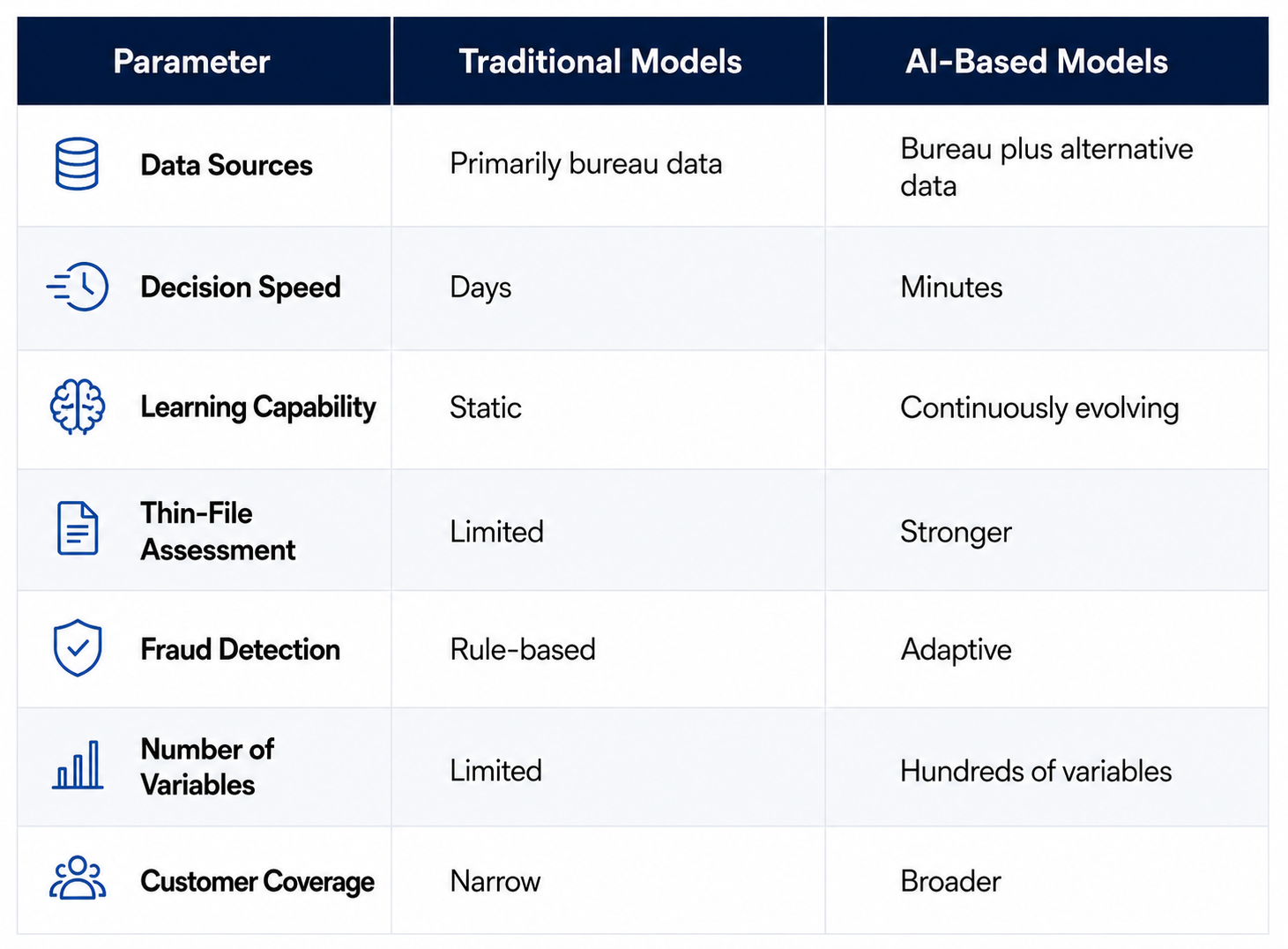
Traditional models primarily evaluate past credit behavior. AI models attempt to predict future repayment capacity using a broader financial context.
Benefits Of AI Credit Scoring
AI-powered credit scoring offers more than just faster approvals; it helps banks and NBFCs make smarter lending decisions while improving operational efficiency. By leveraging data-driven insights, lenders can enhance risk management and deliver better customer experiences.
Faster Loan Decisions
Quick responses have become a competitive advantage. Borrowers increasingly expect near-instant approvals. Manual verification and traditional underwriting can delay decision-making.
AI automates large portions of the assessment process, reducing turnaround times from days to minutes. This can significantly improve customer experience and conversion rates.
Enhanced Financial Inclusion
Many creditworthy individuals remain outside the formal lending ecosystem. By analysing alternative data, banks and NBFCs can responsibly extend credit to:
- First-time borrowers.
- Small business owners.
- Gig economy workers.
- Rural entrepreneurs.
- Self-employed professionals.
This expands addressable markets without compromising underwriting discipline.
Better Risk Assessment
AI analyses far more variables than conventional methods. Subtle behavioral patterns often reveal repayment tendencies that traditional models may overlook. This improves portfolio quality by identifying both hidden opportunities and emerging risks.
Reduced Operational Costs
Automation reduces dependency on manual reviews as live data is analyzed. This improves analysis accuracy, can lower underwriting costs, increase operational efficiency, and enable lean teams to focus on a larger customer base.
Improved Customer Experience
Simplified documentation requirements and faster approvals create a smoother borrowing journey. For digital-first customers, convenience can be a major differentiator.
AI And Fraud Detection
Fraud prevention is another major advantage. Identity manipulation and document tampering continue to challenge lenders.
AI systems can detect anomalies such as:
- Sudden transaction spikes.
- Income inconsistencies.
- Duplicate identities.
- Unusual behavioral patterns.
- Mismatches across datasets.
These capabilities strengthen fraud controls while minimizing friction for genuine borrowers.
How Does AI Credit Scoring Work?
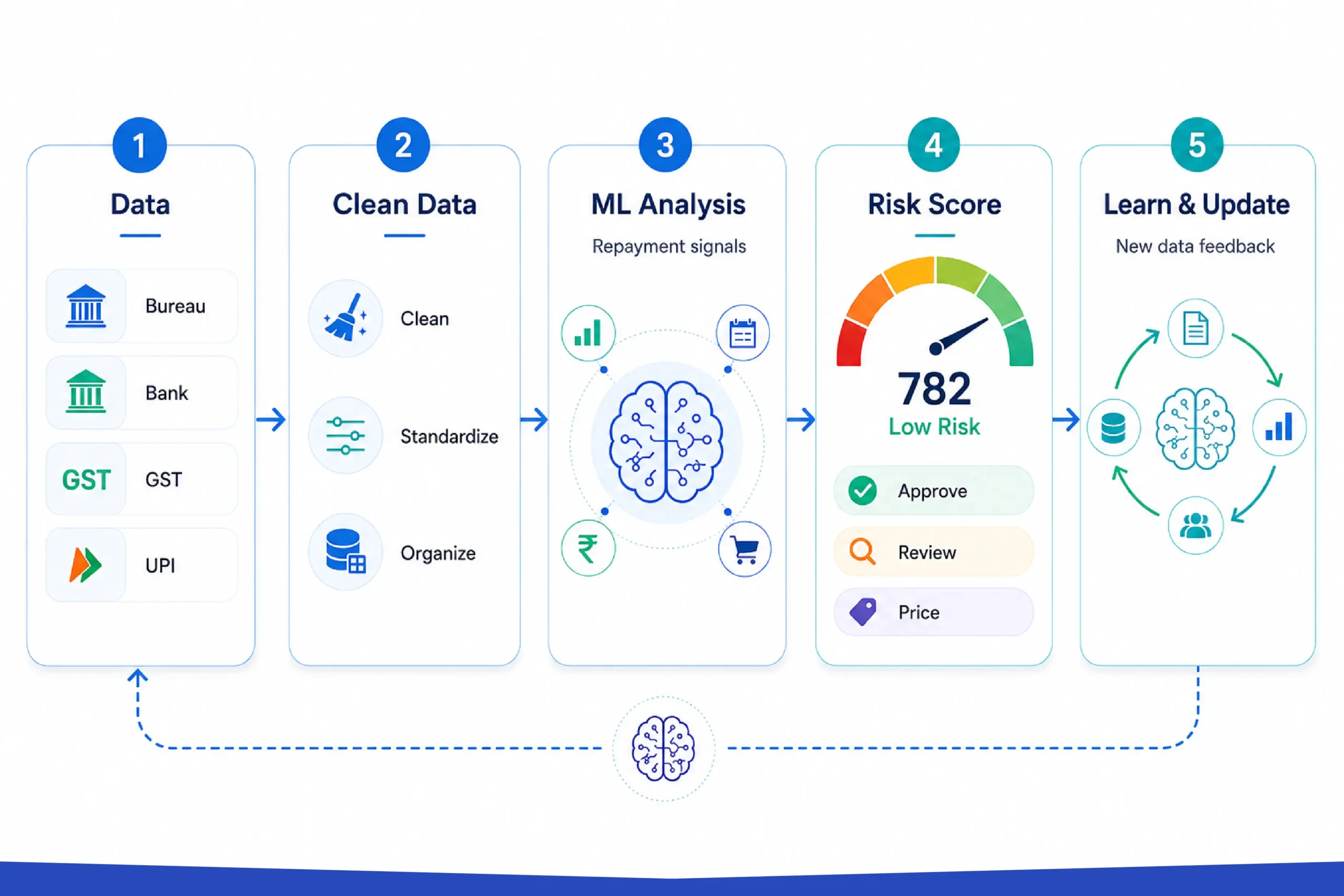
Understanding the underlying process helps NBFC leaders appreciate where the real value lies.
1. Data Collection
The process begins by gathering information from multiple sources.
These may include:
- Credit bureau reports.
- Bank transaction histories.
- GST filings.
- UPI payment patterns.
- Account Aggregator data.
- Income and cash flow records.
- Existing loan performance data.
By combining traditional and alternative data sources, NBFCs can generate borrower insights.
2. Data Processing
Raw data is rarely ready for immediate use. AI systems clean, standardize, and organize information before analysis. Missing values are addressed, inconsistencies are flagged, and relevant variables are extracted. This preprocessing stage ensures that the models work with reliable inputs.
3. Pattern Recognition
Machine learning algorithms are trained using historical lending outcomes. Over time, these models identify relationships between borrower behaviors and repayment performance.
For example, consistent GST filing combined with stable account activity may indicate strong repayment capability, even in the absence of a lengthy bureau history.
4. Risk Prediction
The model then assigns a probability of default or generates a risk score.
NBFCs can use these scores to:
- Approve loans automatically.
- Route applications for manual review.
- Determine pricing.
- Define credit limits.
- Segment customers based on risk.
5. Continuous Learning
Unlike traditional scorecards that remain static for years, AI models evolve as new data becomes available. This enables NBFCs to adapt to changing market conditions and borrower behavior patterns.
How AI Can Transform MSME Lending?
MSMEs represent a significant growth segment for NBFCs. However, assessing these businesses has traditionally been difficult due to limited formal documentation and fluctuating revenues. AI can address these challenges effectively.
Cash Flow-Based Underwriting
Rather than relying solely on collateral or financial statements, NBFCs can evaluate transaction behavior and revenue patterns. This provides a more realistic picture of business health.
GST-Based Assessment
Regular GST filings create verifiable business records. AI models can analyze filing consistency, turnover trends, and tax payment behavior to assess creditworthiness.
Seasonal Income Recognition
Many MSMEs experience predictable seasonal fluctuations. Traditional systems may interpret such variations negatively. AI models, however, can recognize seasonal patterns and distinguish them from genuine financial stress.
Key Considerations When Implementing AI Credit Scoring Systems
Despite its benefits—such as faster decisions, better risk prediction, expanded access for thin-file borrowers via alternative data (e.g., UPI transactions, GST filings, mobile usage), and reduced defaults—AI adoption in lending requires careful planning to manage risks effectively.
1.Data Quality & Governance
Prioritize clean, integrated datasets (traditional bureau + alternative data like GST, UPI, cash flows). Implement strong governance, bias audits, standard definitions, and continuous monitoring to prevent garbage-in-garbage-out outcomes.
2.Explainability & Transparency
Avoid black-box models. Use XAI tools (e.g., SHAP/LIME) to provide clear, per-applicant reasons for decisions. Essential for regulator audits, borrower appeals, and internal trust.
3.Human Oversight & Hybrid Models
Combine AI with human judgment. Route high-value, complex, or low-confidence cases to experienced underwriters. Maintain human-in-the-loop for exceptions and fairness reviews.
4.Regulatory Compliance & Model Risk Management
Align with RBI guidelines (FREE-AI, model risk framework), DPDP Act, and responsible lending norms. Ensure consent, fairness, documentation, and auditability.
5. Bias & Fairness
Actively detect and mitigate demographic biases (gender, rural, MSME) to avoid discriminatory outcomes and regulatory penalties.
6. Model Validation, Monitoring & Drift
Rigorous testing, ongoing performance tracking, and retraining to handle economic shifts and concept drift.
7. Integration & Scalability
Seamlessly connect with legacy loan origination systems. Plan for real-time processing and high-volume scalability.
8. Talent, Governance & Change Management
Build internal capabilities or partner wisely. Establish board-level AI policies, clear accountability, and training for credit teams.
9. Security, Privacy & Ethics
Protect data, manage third-party risks, and uphold ethical standards for sustainable, trusted deployment.
Best Practices For Adopting AI Credit Scoring
Banks and NBFCs considering implementation can benefit from a phased approach.
- Start Small :Pilot AI models within a specific lending product before expanding enterprise-wide. This allows teams to validate performance and identify gaps.
- Combine Traditional and Alternative Data: Hybrid approaches often produce better outcomes than relying exclusively on one data source. Bureau data still offers valuable predictive insights.
- Monitor Models Continuously: Borrower behavior, economic conditions, and fraud patterns change over time, which can reduce model accuracy. Regular monitoring, performance testing, and recalibration help maintain predictive power and regulatory compliance.
- Establish Governance Frameworks: Clearly define ownership, accountability, escalation processes, and review mechanisms.
- Strong governance supports sustainable adoption: Successful AI adoption requires skilled data scientists, risk analysts, and compliance teams working together. Strong governance frameworks ensure model transparency, accountability, regulatory alignment, and effective oversight throughout the model lifecycle.
- Technology alone is insufficient: Risk teams, data scientists, compliance professionals, and business leaders must collaborate effectively.
Final Thoughts
For banks and NBFCs, AI-based credit scoring is no longer just an emerging innovation—it is becoming a strategic necessity.
The technology enables lenders to make faster decisions, assess risk more accurately, reduce operational inefficiencies, and expand credit access to previously underserved segments.
However, successful adoption requires more than deploying algorithms. It demands strong governance, high-quality data, transparent decision-making, and ongoing human oversight.
Financial institutes that strike the right balance between technology and responsible lending will be better positioned to compete in an increasingly digital credit landscape.
As borrower expectations evolve and data ecosystems expand, AI-powered credit scoring could redefine how NBFCs identify opportunity, manage risk, and drive sustainable growth in the years ahead.
Frequently Asked Questions
How is artificial intelligence transforming credit scoring for banks and NBFCs?
AI enables banks and NBFCs to automate underwriting, assess thin-file borrowers, improve risk prediction, and provide quicker, more personalized lending experiences.
Why are NBFCs adopting AI for credit risk assessment?
NBFCs adopt AI to speed up approvals, improve accuracy, expand financial inclusion, reduce costs, and manage growing lending portfolios effectively.
How can AI improve credit scoring accuracy for banks and NBFCs?
AI analyses multiple variables and behavioral patterns, identifying hidden risks and opportunities that traditional scoring methods may overlook.
What are the benefits of AI-powered credit scoring in digital lending?
AI-powered credit scoring enhances approval speed, customer experience, fraud detection, operational efficiency, and access to credit for underserved borrowers.
Can AI reduce loan defaults and improve portfolio quality?
Yes. AI identifies potential risks early, predicts default probabilities more accurately, and helps NBFCs maintain healthier loan portfolios.
How does AI enhance customer onboarding and loan approvals?
AI streamlines verification and underwriting processes, enabling seamless onboarding and faster loan approvals with minimal documentation requirements.
